
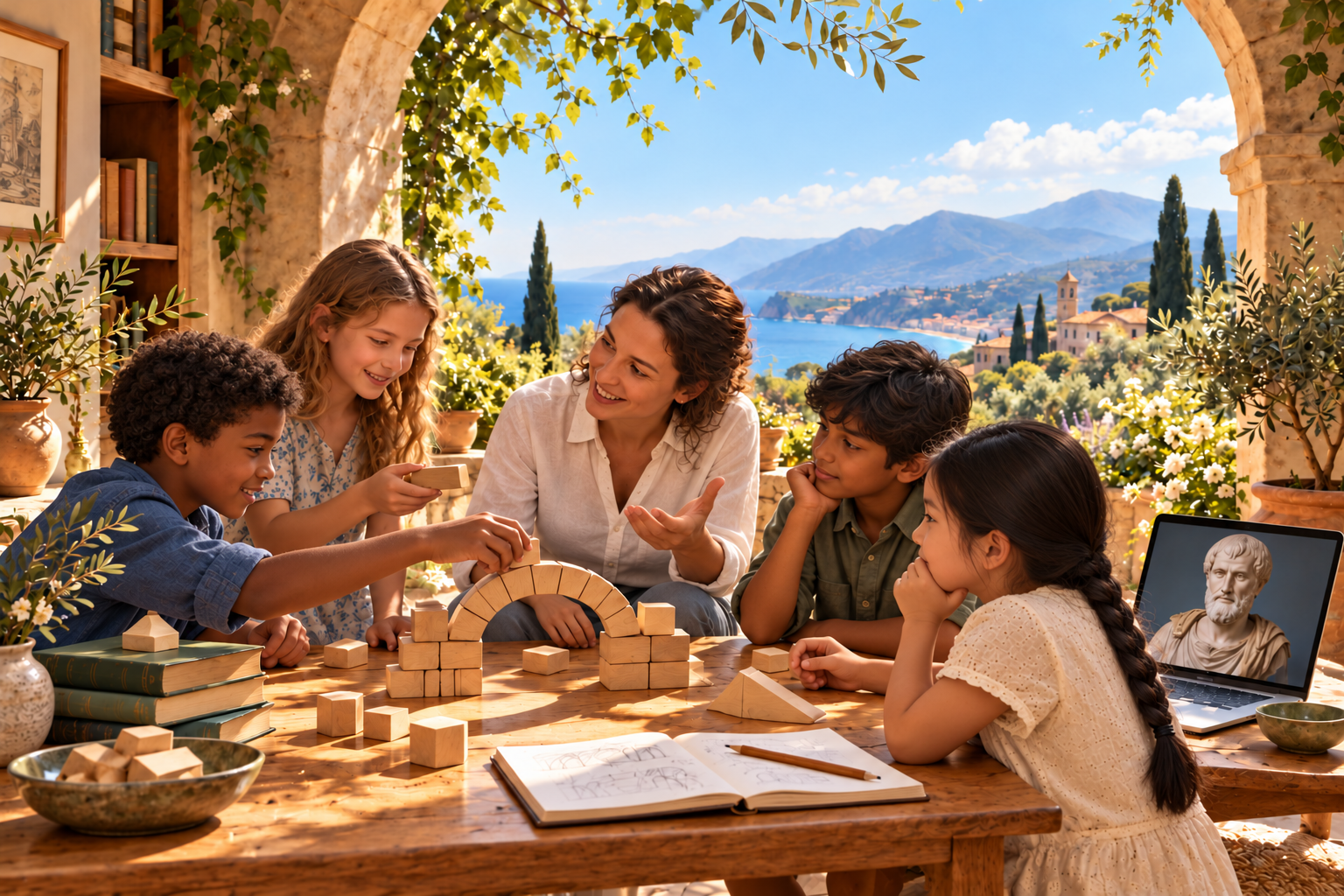
What Is School For?
As Sam Harris said well on the revenge of the humanities, “the world needs well-educated generalists with good aesthetic taste.” So how do we cultivate interdisciplinary range in a world of specialists? How can we use tools like AI aimed at truth, goodness, and beauty without sacrificing humanity’s powerful capacity to specialize (e.g. division of labor) and one’s authentic voice (AV)?
And what is school for? Does it have to do with the origin from Old English scōl, scolu, via Latin from Greek skholē ‘leisure, philosophy, lecture place’?
So far, I think the proper pedagogy—i.e., ideal philosophy of education—is a combination of homeschooling/deschooling/unschooling and classical teaching methods for an increasingly cultivated and civilized populace, especially in a liberal democracy.
Why give priority to the interests and needs of children during formative childhood years? And why revive classical education exposing a student to ‘classical’ literature, history, and languages (especially Latin and Greek) found in the humanities, especially the historical liberal arts of the medieval trivium, specifically rhetoric?
Play, Guidance, and Knowledge
As psychologists like Jean Piaget, Lev Vygotsky, and Jordan Peterson have pointed out, children learn morality through games and play, especially open-ended exploration with firsthand interactions and active experiences à la the constructivism theory of learning (building on existing foundations) and “zone of proximal development” (what the learner can do with guidance) as opposed to passively acquired knowledge through direct instruction and information memorization.
Or as John Locke said,
“learning might be made a play and recreation to children”
John Locke, Some Thoughts Concerning Education, §148.
“Britain’s Strictest Headmistress” Katharine Birbalsingh argues in her successful Michaela school that education should be about teaching children knowledge, not learning skills. Maria Montessori was also successful in a different way. She advocated a child-centered approach to education that developed from her success with children with intellectual disabilities. She sought to develop natural interests and activities rather than use formal teaching methods, within a carefully prepared environment with structured materials and teacher guidance.
I also think the School of Thought’s motto and Jordan Peterson’s focus on his online education platform Peterson Academy of “teaching students how to think, not what to think” is important. But perhaps it depends on the stage and whether it’s in a vacuum. Effective critical thinking is less likely without a strong foundation of relevant factual knowledge across disciplines.
For prolepsis, before you accuse me of an uncompromising naturalistic approach of the noble savage à la Rousseau and emotional pampering—although I am partial to ideas like the inner child on the positive side (e.g. a person’s supposed original or true self)—I think there are feral and basic tendencies on the negative side (e.g. pleasure and pain, mimicry) before growing up to other stages of life.
Hence the need for civilization to make us civilized despite tradeoffs, although perhaps too much in the widely discredited “industrial factory model” that Seth Godin criticizes in Stop Stealing Dreams, which he describes as heavily derived from the 1800s Prussian military and educational systems at the other end of the spectrum for compliant, predictable, and obedient factory workers despite the idealized language of German words like kindergarten or ‘children’s garden’.
Classical Education and Digital Aristotle
As for a renaissance of classical education by nudging—not forcing so as to avoid a reactance cognitive bias—toward learning or literature concerned with human culture, especially rhetoric as the art of effective or persuasive speaking or writing, schools are rediscovering oral examinations in response to students’ growing ability to outsource academic work to generative AI (as well as Socratic classroom discussions like Wonder School and Acton Academy where demonstrating understanding is harder to fake).
However, as a techno-protopian who’s on balance optimistic on technology like AI in the long term—especially as self-paced, custom tutors like a digital, personalized Aristotle or Khanmigo—I think like any neutral tool, it depends on how it’s used (e.g. mindless entertainment vs. mindful edutainment).
Spark the innate curiosity that children have by leaving them inspired and wanting to dig deeper, i.e., breathe into them truths/ideas like oxygen fueling a fire of intrinsic motivation and autodidactic self-feeding.
“Education is not the filling of a pail, but the lighting of a fire”
—a later paraphrase of an idea in Plutarch’s On Listening to Lectures.
Life is a video game. Gamify it—especially learning—by applying typical elements of game playing (e.g. point scoring, competition and cooperation with others, rules of play) to activities like education to educere ‘lead out’ like a maieutic midwife or level up to advance one’s character to the next level of development and together, humanity can progress to the next level. As an addendum, the telos (ultimate purpose or end) of games is not merely victory, but how you play them and develop higher-order desires.
Who knows, maybe we can keep incrementally hacking away at the Dragon-Tyrant of death to make heaven on earth and beyond the earth before a possible heaven after life if the spiritual death problem is already solved in belief systems like Christianity, although even then, would you want to live forever?
Learning to Question
I promise to take a deep-dive into the complexities and nuances of religion later. But for now, as it relates to education, I think indoctrination in the modern sense—the process of teaching a person or group to accept a set of beliefs uncritically—should be avoided. Instead, I favor teaching the history of religion and comparative religion in a more academic, neutral, objective, and analytical way before a theological one within a specific tradition and proving which is objectively true.
In an age of increasingly polluted information ecosystems, erosion of trust in institutions, and non-expert citizen journalism, skills like media literacy—the ability to critically analyze stories presented in the mass media and to determine their accuracy or credibility—and the ability to critically question beliefs, especially one’s own core existing beliefs, are paramount to avoid confirmation bias, belief bias, the backfire effect, and the Dunning–Kruger effect. Rather than telling readers or kids what to think—especially unfalsifiable or unprovable hypotheses—present diverse angles so they can evaluate the facts and decide for themselves.
The lifeblood of the liberal arts is debate, dialectic, inquiry, and challenge, and criticism is the backbone of the scientific method. So try playing devil’s advocate in order to provoke debate or test the strength of the opposing arguments—not in the spirit of philonikia (love of victory and dominance), but in the spirit of philosophia (love of truth and wisdom). And try critical deference as a middle way between ultracrepidarianism (offering opinions beyond one’s knowledge) and credentialism (blindly deferring to authority or institutional status).
Leave a Reply